Oh Those Petrels
[This post written 6/29/08; position: lat -52’55”, long -66’46”; temp 4C; wind chill -10C]
In response to Tracy’s comment on yesterday’s post, thank you, Tracy. I’m very glad to hear you’ve enjoyed the virtual trip. I’ve certainly enjoyed writing about it, and having such a great excuse to take thousands of pictures! Will I be joining the scientists for the March voyage? No, I won’t be. Someone else will have their turn at an Antarctic adventure next March. 🙂
 Today, finding myself at leisure, the sun out, and the temperature above freezing, I spent some time out on deck. We have had petrels following the ship ever since we left iceberg A43K a few days ago. The ones I enjoyed watching today were Cape and giant petrels. I estimate that I have about a thousand pictures of petrels by now, most of them truly crummy, because it’s so hard to photograph birds while they are flying. I’m better at it now than I was at the start of the voyage, but that is not saying much. Still, it was great to be outside in the sun. The wind no longer has the biting quality it did further south. With the wind chill now in the minus single digits during the day (and the days much longer!) it felt quite mild out there.
The top picture doesn’t really capture it, but the sea in the ship’s wake was particularly beautiful today. The sun shimmered on the white tips of the waves. In places, the water was so luminous that it seemed to be lit from within, glowing blue-green. The Cape petrels are always fun to watch, they are so skillful in flight — swooping and diving, scooping water with their feet and their beaks. The thing is, they move too fast for this photographer. I took lots of blurry pictures of them. But there were these two giant petrels. Giant petrels are the heavy aircraft of the petrel world, and they move much more slowly than their smaller cousins. Thus, they are a better target for novice photographers. Unfortunately, the best giant petrel picture I got today, lovely though it was, filled the frame to overflowing, mostly cutting off the bird’s head. So I settled for this one. Not as good, but it will give you some idea what I was seeing today in the NBP’s wake.
Now I am off to join the party we’re having down in the galley. The invitation says we should wear our “issued best.” IOW, items of extreme weather clothing we were issued but haven’t worn yet. For me, I guess that’ll be the heavy plaid flannel shirt and the sea boots. We are now in the Strait of Magellan, and the ship’s information screen says our next destination is “A pub with libations.” We should be in Punta Arenas by 10:00 a.m. local time tomorrow. Ah, solid ground, be kind to me, please.

 As you can see from the pictures, today we got a tour of the Nathaniel B. Palmer’s engine room, which is one of the cleanest and roomiest I’ve ever been in. Also the loudest. As you can also see, we wore ear protectors part of the time. The NBP has four Caterpillar engines (about 12,000 horsepower total), and even though only two of them were online today, they produce quite a roar. One interesting fact I learned today is that the NBP produces its own fresh water for drinking and bathing by using waste engine heat to desalinate seawater. I suspect this only surprised me because I’m pretty naive about the workings of ships. But it impressed me. There is probably less worry about water usage on this ship than there is back home in California. 🙂
 Sandy, I’m sorry to say I haven’t been able to get any pictures of salp chains. But briefly, salps are small, transparent organisms that live in the sea. Here is a picture of a single salp taken by our shipmate Stephanie Bush, close to life-size. Imagine several dozen of these attached end-to-end in a beautiful, transparent chain. The pink shrimplike things were krill, a favorite food of baleen whales.
 In addition to spending some time on deck today taking a couple of hundred pictures of petrels (two of which are worth keeping, ah the joys of digital photography), I went downstairs to see what was happening in the labs. Things were pretty quiet. The researchers are carefully packing up the equipment they so carefully unpacked and arranged in the ship’s labs just a month ago. They are also preparing their samples for shipping, which is complicated by the need for temperature control and customs paperwork. To my surprise, I found the hydrolab and the hallway outside it pretty much completely occupied by the nets of the MOCNESS. And what would these nets be doing spread out on the deck? Ah. The nets get holes in them in the normal course of things — from snags in the water, from being hauled on board filled with their catch, etc. And these have to be meticulously repaired before the MOCNESS is stored away for safekeeping.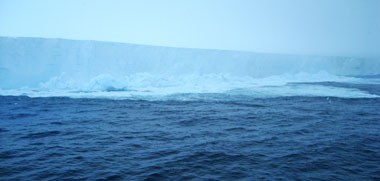
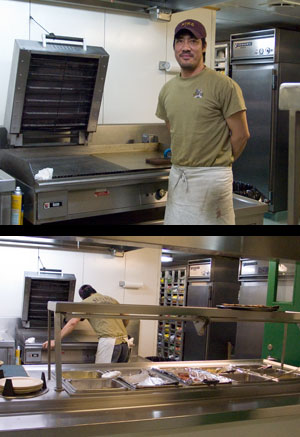 At any rate, it was a quiet day. When it was time to write today’s post, nothing came immediately to mind. Then I remembered that I’ve been wanting to write a little something about the food on the NBP, which is delicious, and in many ways amazing. The head cook, Nestor, is hard to catch sight of because he is always working behind scenes. These are pictures of Lorenzo, one of Nestor’s helpers. He tends the griddle and does a lot of the fry cooking. His pancakes are among the best I have ever eaten.
 It’s been another interesting day aboard the NBP. I think I mentioned that yesterday we passed through an area where there were a lot of free-floating chunks of ice in the water, many with a distinctive brown stripe running through them. Tim Shaw captured a piece that included this peculiar stripe. Last night, while the sample was still frozen, he theorized that the stripe might be a layer of ash or dust from a volcano. But today, after it thawed, it became clear that the stripe is composed of biological material of some sort. Tim says it smells like fish, and is probably a layer of algae. He gave the biologists a sample to work on, and they will try to determine what it is. The picture above shows one of these chunks. This particular piece was about the size of a small car.
 I heard at breakfast that the drone the engineers launched last night was recovered, so everything was set for the launch of the real thing this morning — a Lagrangian Sediment Trap (or LST). The LST is a fairly complex device designed to capture particulate matter as it drifts downward beneath an iceberg. It can be programmed to sink to a specified depth, stay there for a specified length of time or until a specified amount of material has collected, then return to the surface and signal that it’s ready to be picked up. The top picture shows the LST being launched. In the middle, you can see it on deck with some people for scale. The red flag on top makes it easier to see it as it floats on the surface waiting to be retrieved. The funnel-like objects are just what they look like. Sediment drops into the wide mouths of the funnels and falls through narrow tubes into receptacles.
 As I write this, the wind on the bridge is gusting around 40 miles per hour, and the swells are running 15 feet high. Believe it or not, the weather is better now than it was earlier in the day!
 This contraption is known as a rosette. It is a frame holding a couple of dozen PVC bottles, each of which can be opened at a different depth to capture a water sample. The entire device is hoisted on a thick cable and lowered into the water through the NBP’s huge “back door.” Your photographer was standing with her back to it when this picture was taken. Left to right, helping to move the samples from the rosette into labeled bottles are Karie Sines, Adrian Cefarelli, and Nicole Middaugh.