Desert Candy
[This post written on Thursday, 5/29/08, late at night, but not posted till the next day.]
I swear a most excellent oath that I will never again take the Internet for granted. Also, will never again take for granted my desktop computer. My big-screen Apple monitor. My mouse that actually works. Sigh. If you are reading this message on the blog, you’ll know I have had some victories that would seem trivial at home in California, but are major here in Punta Arenas. Either that or my much-loved-and-missed spouse has taken up his duties as Blogger by Email in Chief earlier than he expected to.
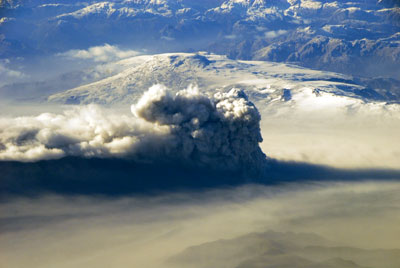
But onward to more interesting subjects. See above! This was the view on Wednesday as we flew from Santiago to Punta Arenas. We were indeed lucky enough to see the Chaiten volcano. My camera was, due to bad planning, impossibly stuck in one of my bags. I couldn’t get to it in time. So the photo above was taken by Brett Hobson. As you can see, the Andes are enormous. You can also see that this cloud of ash looks very different from the clouds. It was unmistakable, an otherworldly sight.
And now, Punta Arenas. How shall I describe it? It is a handful of bright candy scattered in a desert. We arrived here at about 3:00 p.m. yesterday afternoon. The sun was already low in the sky. With the temperature hovering around freezing, shadows were long and crisp, and the air clear and still. That stillness, I gather, is unusual. Take as evidence the trees, many of which grow 30 degrees off vertical, trained by the wind, which rarely ceases and is frequently fierce. This is where the Andes disappear into the sea. I am no meteorologist, but I suspect they play a part in the arid nature of this land. It reminds me very much of the high desert east of the Sierra Nevadas back home.
The town itself had about 125,000 people at last count, but that was in 1990, and the population has grown significantly since then. Why? you might ask, given its location quite literally at the end of the Earth. It has become the main jumping off place for cruises to the Antarctic from this side of the planet. Thus, it is suddenly a hub of ecotourism. [Added later: Recent demand for copper hasn’t hurt, either. Southern Chile produces a sizeable percentage of the world’s copper ore.] For all the harshness of its climate, it is a lovely place. Judged by its architecture, it could be any city in Spain — except for the roofs, which are every brilliant color imaginable. I hope I’ll have time tomorrow to take a walk up the hill for a photograph. But if I don’t, you can see one by Googling “Punta Arenas” and clicking the official web site of the city. Sorry, no Web access tonight, so I’m working from memory. [Added later: for your convenience, click here for more about Punta Arenas.]
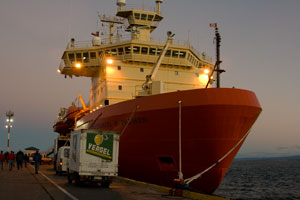 By 4:30, we were on our way to the dock on foot, and the sun had set. I snapped this picture of my first in-person look at the Nathaniel B. Palmer. Up close, it is comfortingly big. There on the dock, a happy reunion took place, of scientists happy to see their delayed colleagues. Our arrival meant everyone could finally begin to make better progress on the hard, frenzied work of getting the scientific and lab equipment offloaded, unpacked, inspected, and arranged — all of which must happen before we can leave port.
I’m drooping and tired again, so I’ll wait till next post to describe today’s adventures at the RPS/ Agunsa Antarctic clothing warehouse. It was quite a circus. But I am now the proud temporary owner of two very big bags full of ultra-warm stuff. Some of it actually fits me. 🙂