The Sea Gives, the Sea Takes
[This post written 6/9/08; position: lat -57’49”, long -44’28”; temp -4C; wind chill -5C]
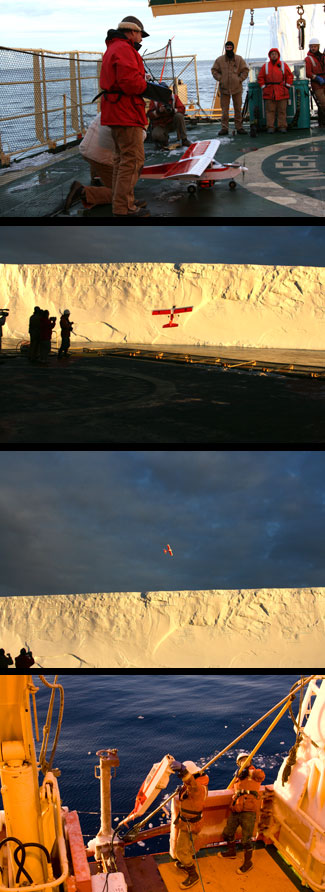 Adventures are creatures of extremes. Fittingly, we have had a day filled with highs and lows.
The sea was calm, and the winds light, and therefore I felt good. 🙂 After breakfast, I donned my many articles of clothing, stuffed a couple of handwarmers in my pockets, grabbed my camera and went out to 0 deck, where Steve Rock and his team were mounting and lowering the multi-beam sonar. If all went well (and it did!), this mechanical marvel would yield an image of the seven-eighths of the iceberg that lay hidden beneath the water. I snapped pictures for an hour, glad for the handwarmers, and then in a glorious instant, even gladder for the sun as it burst out from behind the clouds. Its warmth on my cheeks felt better than the most luxurious silk, the best cognac, the sweetest flowers. I stood there grinning like an idiot, and wouldn’t have traded places with anyone on earth. Strange as it may sound, those minutes were worth all the cold and dark. Odder still, they could not have happened at all without the cold and dark that came before them.
A short time later, Steve E. came down to get me, saying that they were going to try dropping the GPS beacons with the plane. So up a deck I went, to the helopad, where I spent another hour, took a quick break for lunch, and then went back for more while we waited for the sonar team to finish up, and Steve and Kim put the finishing touches on the plane. On deck, the wind was barely a whisper, and I watched, half mesmerized as we circumnavigated the iceberg again and again, sometimes in deep shade, sometimes in the buttery sunlight. What am I looking at, I thought? A huge chunk of ice in the broad ocean, but far more than that. An oasis of life. And a piece of the world no human being has ever touched or even seen before. The ship is a noisy, smelly, very human article, and standing on it, it’s easy to be consumed by it and lose track of what and where we really are — small, lucky creatures in a good place, surely one of the purest places on the planet.
As if to prove the point, just off the stern, the flukes of a whale appeared. Shortly, we saw that the whale was part of a pod, and for a tantalizing half hour, we watched them spout and dive. “Those are Southern Right whales,” said Adam Jenkins, who has spent more time in these parts than the rest of us and ought to know. “They’re rare — hunted nearly to extinction. We’re very lucky to see one.” A moment later someone shouted, “Hey, penguins!” Sure enough, a flock of penguins had joined the whale, fishing. I shot pictures one after another, but got nothing identifiable. Couldn’t tell what type of penguins they were. Maybe another day. That’s a beauty of this trip. There will be other days. Many!
Then the guys were ready to fly the plane. Kim started the little motor and warmed it up. Sunshine blazed along the flank of the iceberg. The wind was still behaving. As planned, Kim guided the plane through takeoff. Up it went, beautiful and bright against the iceberg and then the sky. When it got high enough, Kim transferred control to Steve E. who was stationed in the ship’s ice tower, the tall lookout used for finding a path through fields of ice. All went well. Then as Steve banked the plane to bring it back over the top of the iceberg, a control cable in one of the ailerons snapped, and suddenly the plane was in the water.
It was an awful wreck. The engine snapped off and sank on impact. The wing broke in half. See above as they pulled it in pieces from the water. Well…we have a second plane. And there will be other days.
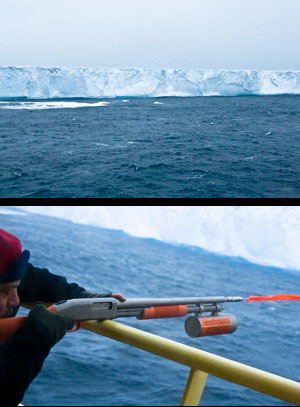 My sea legs seem to have decided they want a vacation in the Bahamas. They are nowhere to be found today, so this one will be short. The sea is black and rough, and there’s a lot of wind out there, which is causing various problems for the scientists and engineers. But we have found our iceberg of dreams — see above. It’s a nice thick tabular berg, about 120 feet high and a couple of miles long, vaguely wedge-shaped when seen in map view. We determined this by sailing the ship around it and looking at the shape of our path, much as the ancient cartographers did — except we have a nice display screen and a computer to plot our path. Heh heh.
 Now that the seasickness is gone, I seem to be coming down with a cold. My roommate picked one up on the airplane during our arduous journey south, so it’s not much wonder that it’s my turn now. I am armed with gan mao ling, my favorite cold remedy — a venerable concoction of Chinese herbs. So maybe I can keep it mild, and keep it from spreading further. Went gratefully to bed at about 9:00 last night, read Stan Robinson’s book Antarctica for a while (wonderful book, BTW), and eventually slept till 7:30 this morning.
 So we have passed the day as best we can, each in our own way. The marine chemists on the Shaw/Twining team have been carefully acid washing all of their sampling equipment. Steve Rock’s sonar team has spent the day repairing the cables that were damaged in yesterday’s accident. The ROV team has been going over yesterday’s videos, which revealed more particulate matter than expected in the water, and many salps — a particular type of gelatinous sea creature. The airplane team took this opportunity to ground-test the plane and its controls to make sure everything works in these cold temperatures. (I tried my hand at the simulator until I had crashed it so many times it got mortifying.) And, of course, everyone is spending time in the mess hall. Meat loaf and mashed potatoes for lunch. So far, so good. 🙂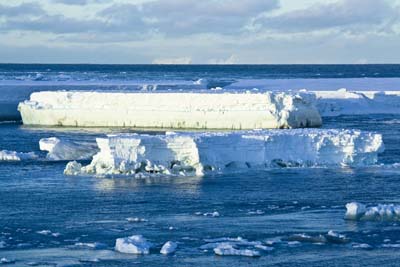
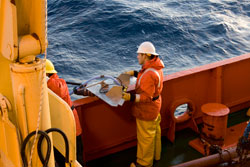 First thing this morning, Steve Rock and his sonar team deployed their multi-beam echosounder, which they will eventually use to create imagery of the underwater portions of the icebergs. In a very close call, the pole mount slipped and fell and the device would have been lost if not for the safety line. A good illustration of the real need for hard hats on 0 deck, and of course, the need for safety lines! The picture to the left shows Ben Twining launching a “fish” water sampling device, which is lowered to the desired depth and then uses a motor to pump up a quantity of seawater. As I type, Bruce Robison and his team are launching the Phantom remotely operated vehicle for a test. Too cold and dark out for this reporter! I’ll take my cozy cabin, thank you. There’s a TV monitor above my head, and I can see them launching the ROV and hear them talking about how things are going. Quite nice. 🙂 But the sea looks very stirred up, and they are not having an easy time.
 Ah, the getting of sea legs. The water turned rougher on Monday morning, and the Scopolomine, though I’m sure it’s helping, apparently has its limits. I have spent much of the past two days in bed. (See photo of my cabin.) The ship is rockin’ and rollin’ for sure, and for me, it’s much easier to tolerate if I’m horizontal. I apologize for the brevity of this post, but looking at a computer screen is kind of the kiss of death.
 At last we are well and truly on our way. On Saturday, May 31, at about 2:00 in the afternoon, the Nathaniel B. Palmer left its berth in Punta Arenas, bound for the open sea. The night before, a large contingent from our group ate a last dinner on land at a restaurant whose name I can’t recall now. I ordered panqueque…now I can’t recall the word for this, either, but the translation is King crab crepes. They were the best I’ve ever eaten. And now I can see that, to do right by my readers, I had better go find the name of the restaurant and post it here. I confess I don’t have the oomph to do it just now, at the end of a long day, and full of Scopolamine. [Added later: The restaurant was Santori’s. The dish “Panqueque Centolla.”]
 The NBP has three of these. Two are fully enclosed and hold 70 passengers each. The other is smaller and open, and its use would clearly be a desperation measure (though it’s probably larger than the boat Shackleton and Worseley sailed from Elephant Island). Inside, the seats are arrayed like those in a military transport — padded, and each with a full safety harness. According to the first mate, such boats bob around like corks, and the ride can be so rough that people get hurt if they’re not well strapped in. There are no windows and precious few lights. I have no doubt it would be nightmarish waiting inside one of those for help to come. Better by far than clinging to a raft in the open sea, though.