The Land of Ice
[This post written 6/5/08; position: lat -60’25”, long -55’13”; temperature -3C, wind chill -21C]
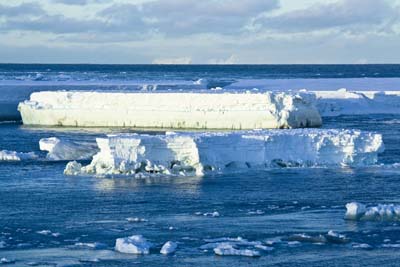
We have entered the land of icebergs, and it is peculiar indeed. Our first sight of them happened yesterday in the fog. Joanna ducked into our cabin and said, “There’s an iceberg out there. Come and see!” So I threw on some jackets and a hat, grabbed my camera, and went out for a look. It was morning, but the fog was so dense that it seemed to be twilight. A gray curtain hung just on the other side of the deck railing, and at first there was nothing to be discerned there. Then someone pointed and said, “Look, there’s a cave.” Ever so dimly through the murk, I made out a dark spot, and as I did so, the rest of the iceberg came into view as well, so close that it towered above us, monstrous. I don’t know how close we actually were. There are formulas for these things — some ratio based on the height of the iceberg, I think. And there is no doubt that we were a safe range away, knowing Captain Mike, who is impressive in his competence. Still, the shock of this thing looming up suddenly through the fog gave me chills. It certainly left me with more sympathy for the crew of the Titanic. Without radar, it would be easy to come upon an iceberg in the fog so quickly that nothing could be done to avert a crash. Apparently, seamen used to detect icebergs in the fog simply by watching the water. If waves from the ship’s wake seem to be going out and then coming back in, it’s because they are bouncing off of something…like an iceberg.
I have my sea legs, I think. It also helps that the water among the icebergs is calmer. The picture above was taken from the bridge at about 9:30 this morning. If you look hard, you can see Elephant Island in the distance, where Shackleton and his men first landed after leaving the Endurance. These are tabular icebergs — so flat because they were once part of an ice shelf. Though it may look like it, we are not in the pack ice. The small pieces of ice in the water are just pieces that have broken off from the big ones, or bits of “pancake ice” beginning to form as the water temperature cools down with the approach of winter. It is a strange thing traveling through this. You can hear the ice on the hull at times, a light scraping sound, like running a spoon through a half frozen drink.
Unless something has changed in the past couple of hours, we are still searching for an ideal iceberg to study. It must be big enough, and the water must be deep enough, and the water around it must be clear enough. There’s a lot of science happening today even so. Peering out my cabin window, I see that we are quite close to a large tabular iceberg that seems to fit all the desired parameters, so maybe we have found what we were looking for. The sun set some time ago (it is 3:30 p.m. now), so I will have to wait till tomorrow’s light to photograph it. It is eerie and beautiful, its edges catching the last faint rays of sun, its splits and crevasses dark, dark, dark. But in such low light, with the ship rocking, it will just be a smear if I try to photograph it now, even with a tripod.
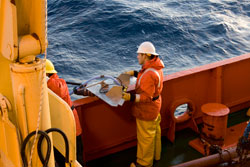 First thing this morning, Steve Rock and his sonar team deployed their multi-beam echosounder, which they will eventually use to create imagery of the underwater portions of the icebergs. In a very close call, the pole mount slipped and fell and the device would have been lost if not for the safety line. A good illustration of the real need for hard hats on 0 deck, and of course, the need for safety lines! The picture to the left shows Ben Twining launching a “fish” water sampling device, which is lowered to the desired depth and then uses a motor to pump up a quantity of seawater. As I type, Bruce Robison and his team are launching the Phantom remotely operated vehicle for a test. Too cold and dark out for this reporter! I’ll take my cozy cabin, thank you. There’s a TV monitor above my head, and I can see them launching the ROV and hear them talking about how things are going. Quite nice. 🙂 But the sea looks very stirred up, and they are not having an easy time.
Orchardgirl asks how Tim and Ben know which nutrients are in the water to begin with and which have been added by Chaiten. At lunch yesterday, Tim explained that volcanic ash has some unique properties that make it easy to detect if it is present. I believe he said one of these is radon, but I will double check that because I don’t have it in my notes. But the gist of it is that volcanic ash contains some special elements that make for fairly easy identification. Plus, I believe they have samples of Chaiten ash, so they know what it contains and in what ratios. I will also try to find out whether they are testing the samples right here on the ship, or will wait till we get home to test it. I suspect they’ll test it here in one of the wet labs. [Added later: It isn’t radon. Also, Tim didn’t have all the equipment and materials he needed to test for Chaiten ash on the ship, so this will be done in his lab in South Carolina.]
I will ask Captain Mike tomorrow if he can tell me a little about why the NBP rides so high in the water. Another person who might know is Bruce Robison, who watched the ship being built in 1992. I have seen film clips of icebreakers at work, and it is a sight to behold. They are built to run up on top of the ice and crash down on it, breaking it. So maybe that has something to do with their riding high.
Well, I should get this mailed off for posting. Don’t worry about us. We are in good hands.
Wow, that’s cool how the icebergs suddenly loom up through the fog. Definitely makes more sense of the Titanic.
Glad to hear that you are safe and getting your sea legs. We all miss you and love you a lot! Stay safe! 🙂
xxxooo